Tag Archives: networking

Horizon Wi-Free Access on Linux

Horizon Wi-Free is an 802.1x authenticated network service intended to allow UPC customers to use WiFi Offload via UPC broadband routers. Essentially almost all UPC modems are broadcasting a “Horizon Wi-Free” SSID, and authenticating via 802.1x in the backend.

Note: You cannot connect to Horizon Wi-Free through your own router, so you will have to test against another customer’s one! I believe the idea behind this is to prevent you using the ‘roaming’ network while at home.

Configuring wpa_supplicant.conf

Main points here are:

  • SSID: this should be “Horizon Wi-Free”
  • parwise and group = CCMP
  • EAP: This needs to be PEAP as a username and password are required
  • identity: this is your UPC Wi-Free username
  • password: the Wi-Free password, not your web account password
  • ca_cert: This cert is to verify that we are actually connecting to a network belonging to UPC (see below)
  • phase2: This must be MSCHAPV2
network={
   ssid="Horizon Wi-Free"
   key_mgmt=WPA-EAP
   pairwise=CCMP
   group=CCMP
   eap=PEAP
   identity="username"
   password="my_secret_password"
   ca_cert="/etc/cert/liberty_global.pem"
   phase1="peapver=0"
   phase2="MSCHAPV2"
   id_str="horizon-free-wifi"
}


Getting the CA Cert for Network Verification

This step was a little more work then expected, as I had to track down a copy of the CA cert. The easiest way is to download the .mobileconfig file intended for iOS and extract the required cert chain:

wget http://www.upc.ie/horizonwifreedevicesetup/applesecurity/

[user.local][~/Downloads]=> openssl pkcs7 -inform DER -print_certs -in ./HorizonWi-Freev1.mobileconfig
 
subject=/O=AlphaSSL/CN=AlphaSSL CA - G2
issuer=/C=BE/O=GlobalSign nv-sa/OU=Root CA/CN=GlobalSign Root CA
-----BEGIN CERTIFICATE-----
MIIELzCCAxegAwIBAgILBAAAAAABL07hNwIwDQYJKoZIhvcNAQEFBQAwVzELMAkG
A1UEBhMCQkUxGTAXBgNVBAoTEEdsb2JhbFNpZ24gbnYtc2ExEDAOBgNVBAsTB1Jv
b3QgQ0ExGzAZBgNVBAMTEkdsb2JhbFNpZ24gUm9vdCBDQTAeFw0xMTA0MTMxMDAw
MDBaFw0yMjA0MTMxMDAwMDBaMC4xETAPBgNVBAoTCEFscGhhU1NMMRkwFwYDVQQD
ExBBbHBoYVNTTCBDQSAtIEcyMIIBIjANBgkqhkiG9w0BAQEFAAOCAQ8AMIIBCgKC
AQEAw/BliN8b3caChy/JC7pUxmM/RnWsSxQfmHKLHBD/CalSbi9l32WEP1+Bstjx
T9fwWrvJr9Ax3SZGKpme2KmjtrgHxMlx95WE79LqH1Sg5b7kQSFWMRBkfR5jjpxx
XDygLt5n3MiaIPB1yLC2J4Hrlw3uIkWlwi80J+zgWRJRsx4F5Tgg0mlZelkXvhpL
OQgSeTObZGj+WIHdiAxqulm0ryRPYeDK/Bda0jxyq6dMt7nqLeP0P5miTcgdWPh/
UzWO1yKIt2F2CBMTaWawV1kTMQpwgiuT1/biQBXQHQFyxxNYalrsGYkWPODIjYYq
+jfwNTLd7OX+gI73BWe0i0J1NQIDAQABo4IBIzCCAR8wDgYDVR0PAQH/BAQDAgEG
MBIGA1UdEwEB/wQIMAYBAf8CAQAwHQYDVR0OBBYEFBTqGVXwDg0yxh90M7eOZhpM
EjEeMEUGA1UdIAQ+MDwwOgYEVR0gADAyMDAGCCsGAQUFBwIBFiRodHRwczovL3d3
dy5hbHBoYXNzbC5jb20vcmVwb3NpdG9yeS8wMwYDVR0fBCwwKjAooCagJIYiaHR0
cDovL2NybC5nbG9iYWxzaWduLm5ldC9yb290LmNybDA9BggrBgEFBQcBAQQxMC8w
LQYIKwYBBQUHMAGGIWh0dHA6Ly9vY3NwLmdsb2JhbHNpZ24uY29tL3Jvb3RyMTAf
BgNVHSMEGDAWgBRge2YaRQ2XyolQL30EzTSo//z9SzANBgkqhkiG9w0BAQUFAAOC
AQEABjBCm89JAn6J6fWDWj0C87yyRt5KUO65mpBz2qBcJsqCrA6ts5T6KC6y5kk/
UHcOlS9o82U8nxTyaGCStvwEDfakGKFpYA3jnWhbvJ4LOFmNIdoj+pmKCbkfpy61
VWxH50Hs5uJ/r1VEOeCsdO5l0/qrUUgw8T53be3kD0CY7kd/jbZYJ82Sb2AjzAKb
WSh4olGd0Eqc5ZNemI/L7z/K/uCvpMlbbkBYpZItvV1lVcW/fARB2aS1gOmUYAIQ
OGoICNdTHC2Tr8kTe9RsxDrE+4CsuzpOVHrNTrM+7fH8EU6f9fMUvLmxMc72qi+l
+MPpZqmyIJ3E+LgDYqeF0RhjWw==
-----END CERTIFICATE-----

subject=/OU=Domain Control Validated/CN=*.upcbroadband.com
issuer=/O=AlphaSSL/CN=AlphaSSL CA - G2
-----BEGIN CERTIFICATE-----
MIIEtzCCA5+gAwIBAgISESEulCUW/1LPLh5Wj7dtRUYSMA0GCSqGSIb3DQEBBQUA
MC4xETAPBgNVBAoTCEFscGhhU1NMMRkwFwYDVQQDExBBbHBoYVNTTCBDQSAtIEcy
MB4XDTEzMDExNjEyMzY0M1oXDTE1MDExNzEyMzY0M1owQDEhMB8GA1UECxMYRG9t
YWluIENvbnRyb2wgVmFsaWRhdGVkMRswGQYDVQQDDBIqLnVwY2Jyb2FkYmFuZC5j
b20wggEiMA0GCSqGSIb3DQEBAQUAA4IBDwAwggEKAoIBAQCh0AMi+hy7flw92BCL
dXuXeFVFGSE9nXnzhspXIPVTkMMGHfZrkbxw3DzTrLD490X3o3UcQ8gxwU80jf7I
71wpxaXLdUxAFk2IpgSb6hAtOiBGtioTx8/5ZxlGW+c1JPb6ompslyY4fe4f9y3k
9u6cIKAzttnTNLCOe1IUIfy1HjjDm3/lzVuuV4N7eu/bYtPE6RB8xpm/3lK2cRCB
T8ueRokeU3Wiq3mZSKenT54rw+3kWBFfAAKVjyNHctQHlrtzSal28JQJ/tVLhhOM
sDO0kss0y+U0wbzjc/sfjBHDaNxboTc4C9MwzEScNrn9WH8qj/xT+nHTFBITiqSh
1EF5AgMBAAGjggG7MIIBtzAOBgNVHQ8BAf8EBAMCBaAwTQYDVR0gBEYwRDBCBgor
BgEEAaAyAQoKMDQwMgYIKwYBBQUHAgEWJmh0dHBzOi8vd3d3Lmdsb2JhbHNpZ24u
Y29tL3JlcG9zaXRvcnkvMC8GA1UdEQQoMCaCEioudXBjYnJvYWRiYW5kLmNvbYIQ
dXBjYnJvYWRiYW5kLmNvbTAJBgNVHRMEAjAAMB0GA1UdJQQWMBQGCCsGAQUFBwMB
BggrBgEFBQcDAjA6BgNVHR8EMzAxMC+gLaArhilodHRwOi8vY3JsMi5hbHBoYXNz
bC5jb20vZ3MvZ3NhbHBoYWcyLmNybDB/BggrBgEFBQcBAQRzMHEwPAYIKwYBBQUH
MAKGMGh0dHA6Ly9zZWN1cmUyLmFscGhhc3NsLmNvbS9jYWNlcnQvZ3NhbHBoYWcy
LmNydDAxBggrBgEFBQcwAYYlaHR0cDovL29jc3AyLmdsb2JhbHNpZ24uY29tL2dz
YWxwaGFnMjAdBgNVHQ4EFgQUidh6RCyiMnWkZqNJ+NrOP9APjIswHwYDVR0jBBgw
FoAUFOoZVfAODTLGH3Qzt45mGkwSMR4wDQYJKoZIhvcNAQEFBQADggEBABMneGO7
KOzZ7pEB4NN9rHDizfz+3fauF68WQz9V3+byP53mwZWgfpX80nxi1uD3qGzgaNUB
mgenNxrsvziw1aiDAgMiwc+uhN8BYh/cezfp+pe2qBnyeu2CJBQ9tLIyyBp7cCl3
PGNSBhXr4xBxsfVV+4xqk7aLkG9aVelPIrQWokwPZ5VWBxjSAmrWipvPRfzb7IeA
DVM9W1ZhxyDY1D7d6F56Q0WTTNAsV/nWv9sNOlkME9lpF4ytpvxNHLHgO7cKvgr/
lTZMhfRdQB9Djn3OJ22O5AratklkkxJquvIAOYHvg6GEhWk+IFbg2Lkrn6tuPwB5
W24J6nCgFx/jzvc=
-----END CERTIFICATE-----

Throw these into a file and get openssl to verify:

[user@machine][~]=> openssl verify liberty_global.pem
liberty_global.pem: OK

While the theory behind this is sound, unfortunately there was an issue when I attempted to test the connection:

SSL: SSL_connect:SSLv3 read server hello A
TLS: Certificate verification failed, error 19 (self signed certificate in certificate chain) depth 2 for '/C=NL/O=Liberty Global Operations B.V./OU=Root CA0001/CN=Liberty Global Root Certification Authority'
wlan1: CTRL-EVENT-EAP-TLS-CERT-ERROR reason=1 depth=2 subject='/C=NL/O=Liberty Global Operations B.V./OU=Root CA0001/CN=Liberty Global Root Certification Authority' err='self signed certificate in certificate chain'
SSL: (where=0x4008 ret=0x230)
SSL: SSL3 alert: write (local SSL3 detected an error):fatal:unknown CA
SSL: (where=0x1002 ret=0xffffffff)
SSL: SSL_connect:error in SSLv3 read server certificate B
OpenSSL: openssl_handshake - SSL_connect error:14090086:SSL routines:SSL3_GET_SERVER_CERTIFICATE:certificate verify failed
SSL: 7 bytes pending from ssl_out
SSL: Failed - tls_out available to report error
SSL: 7 bytes left to be sent out (of total 7 bytes)

Apparently OpenSSL blows a fuse when pointed at the CA cert, as it seemingly tries to authenticate the CA cert against a higher authority – since this is a root cert that is not possible. Apparently I’m not the first to see this little problem.

Quick workaround is to disable the CA Cert setting in the wpa_supplicants file and we are in business:

SSL: SSL_connect:SSLv3 read server hello A
TLS: tls_verify_cb - preverify_ok=1 err=19 (self signed certificate in certificate chain) ca_cert_verify=0 depth=2 buf='/C=NL/O=Liberty Global Operations B.V./OU=Root CA0001/CN=Liberty Global Root Certification Authority'
wlan1: CTRL-EVENT-EAP-PEER-CERT depth=2 subject='/C=NL/O=Liberty Global Operations B.V./OU=Root CA0001/CN=Liberty Global Root Certification Authority'
TLS: tls_verify_cb - preverify_ok=1 err=19 (self signed certificate in certificate chain) ca_cert_verify=0 depth=1 buf='/C=NL/O=Liberty Global Operations B.V./OU=HORIZON Service Operator CA0001/CN=Liberty Global HORIZON Service Operator Certification Authority'
wlan1: CTRL-EVENT-EAP-PEER-CERT depth=1 subject='/C=NL/O=Liberty Global Operations B.V./OU=HORIZON Service Operator CA0001/CN=Liberty Global HORIZON Service Operator Certification Authority'
TLS: tls_verify_cb - preverify_ok=1 err=19 (self signed certificate in certificate chain) ca_cert_verify=0 depth=0 buf='/CN=Liberty Global WiFi/OU=HORIZON/O=Liberty Global Operations B.V./C=NL'
wlan1: CTRL-EVENT-EAP-PEER-CERT depth=0 subject='/CN=Liberty Global WiFi/OU=HORIZON/O=Liberty Global Operations B.V./C=NL'
SSL: (where=0x1001 ret=0x1)
SSL: SSL_connect:SSLv3 read server certificate A
SSL: (where=0x1001 ret=0x1)
SSL: SSL_connect:SSLv3 read server done A
SSL: (where=0x1001 ret=0x1)
SSL: SSL_connect:SSLv3 write client key exchange A
SSL: (where=0x1001 ret=0x1)
SSL: SSL_connect:SSLv3 write change cipher spec A
SSL: (where=0x1001 ret=0x1)
SSL: SSL_connect:SSLv3 write finished A
SSL: (where=0x1001 ret=0x1)
SSL: SSL_connect:SSLv3 flush data
SSL: (where=0x1002 ret=0xffffffff)
SSL: SSL_connect:error in SSLv3 read finished A
SSL: SSL_connect - want more data
SSL: 318 bytes pending from ssl_out
SSL: 318 bytes left to be sent out (of total 318 bytes)
EAP: method process -> ignore=FALSE methodState=MAY_CONT decision=FAIL
EAP: EAP entering state SEND_RESPONSE
EAP: EAP entering state IDLE
EAPOL: SUPP_BE entering state RESPONSE
EAPOL: txSuppRsp
TX EAPOL: dst=54:88:0e:b8:5d:79
TX EAPOL - hexdump(len=332): 01 00 01 48 02 07 01 48 19 80 00 00 01 3e 16 03 01 01 06 10 00 01 02 01 00 75 1a fa 59 f4 52 82 d3 c2 c4 da 8e 12 6b 25 ab bd 77 93 3c a4 0f bb a0 34 bf f9 63 d0 4c 8a 2d 5d 71 11 24 a6 33 71 8e 8f b9 87 36 18 21 b8 c0 09 11 3a 59 6a 6a 77 65 b3 75 69 24 75 8f be ef 2b 07 2c 20 78 89 84 6e 54 dd f0 34 80 d8 39 cf 6b 5c 10 cb cf 99 90 d5 12 7f 5d 08 17 49 79 28 d1 23 11 c5 dc 2f a7 19 2c e2 c4 5d 4b 35 18 93 dc c5 e9 6d 82 40 ff 13 a6 19 79 dd fb c6 20 e6 0a 02 4f 24 90 3b 5c ea 6a 1b 80 16 85 9e ab 04 51 b4 ac dd dd a5 59 b1 84 12 89 65 a9 64 82 f7 7f f2 6c 48 5d 0f e7 7d c8 5b 60 ee 8a 41 98 55 4e c2 92 55 8e b1 0a dd 55 d5 4f 7b 2d 0a 4a 8b df 1a e1 cf 12 0d cd c5 3e 45 18 e9 69 cb 96 5a 9e 69 cd 4d 72 63 07 ab ab c0 c4 a1 04 e1 2f ad 12 a9 c9 82 9c 1b fe 8e a1 d7 48 6c 6e dd 90 08 5d 8a 5f 0b 54 eb b0 4e e8 17 04 45 64 2e 67 6d 14 03 01 00 01 01 16 03 01 00 28 11 ea 76 36 ea 35 2f 95 eb f3 ff 22 9e 41 31 17 08 f9 e5 53 48 b1 96 c9 f7 6d a3 9b 25 f7 7a cb b3 a9 5d 8f f2 9e 9e 02
EAPOL: SUPP_BE entering state RECEIVE
wlan1: RX EAPOL from 54:88:0e:b8:5d:79
RX EAPOL - hexdump(len=63): 01 00 00 39 01 08 00 39 19 00 14 03 01 00 01 01 16 03 01 00 28 03 7e 2e d8 7e ce 49 a8 3e 53 d3 90 47 40 b3 c7 00 f2 00 7d d0 23 ae ba 9a 27 2d cd aa 0b 7f 68 52 48 f6 4a 58 f6 11 89 00 00
EAPOL: Received EAP-Packet frame
EAPOL: SUPP_BE entering state REQUEST
EAPOL: getSuppRsp
EAP: EAP entering state RECEIVED
EAP: Received EAP-Request id=8 method=25 vendor=0 vendorMethod=0
EAP: EAP entering state METHOD
SSL: Received packet(len=57) - Flags 0x00
SSL: (where=0x1001 ret=0x1)
SSL: SSL_connect:SSLv3 read finished A
SSL: (where=0x20 ret=0x1)
SSL: (where=0x1002 ret=0x1)
SSL: 0 bytes pending from ssl_out
SSL: No Application Data included
SSL: No data to be sent out
EAP-PEAP: TLS done, proceed to Phase 2
EAP-PEAP: using label 'client EAP encryption' in key derivation
EAP-PEAP: Derived key - hexdump(len=64): [REMOVED]
SSL: Building ACK (type=25 id=8 ver=0)
EAP: method process -> ignore=FALSE methodState=MAY_CONT decision=FAIL
EAP: EAP entering state SEND_RESPONSE
EAP: EAP entering state IDLE
EAPOL: SUPP_BE entering state RESPONSE
EAPOL: txSuppRsp
TX EAPOL: dst=54:88:0e:b8:5d:79
TX EAPOL - hexdump(len=10): 01 00 00 06 02 08 00 06 19 00
EAPOL: SUPP_BE entering state RECEIVE
wlan1: RX EAPOL from 54:88:0e:b8:5d:79
RX EAPOL - hexdump(len=41): 01 00 00 23 01 09 00 23 19 00 17 03 01 00 18 ee f5 c3 a9 be 73 08 05 92 fd e0 52 73 8b 2a 53 a5 d9 64 8d cc 3c 20 f6 00 00
EAPOL: Received EAP-Packet frame
EAPOL: SUPP_BE entering state REQUEST
EAPOL: getSuppRsp
EAP: EAP entering state RECEIVED
EAP: Received EAP-Request id=9 method=25 vendor=0 vendorMethod=0
EAP: EAP entering state METHOD
SSL: Received packet(len=35) - Flags 0x00
EAP-PEAP: received 29 bytes encrypted data for Phase 2
EAP-PEAP: Decrypted Phase 2 EAP - hexdump(len=1): 01
EAP-PEAP: received Phase 2: code=1 identifier=9 length=5
EAP-PEAP: Phase 2 Request: type=1
EAP: using real identity - hexdump_ascii(len=8):
63 6f 6c 69 6e 6d 61 63                           colinmac
EAP-PEAP: Encrypting Phase 2 data - hexdump(len=13): [REMOVED]
SSL: 66 bytes left to be sent out (of total 66 bytes)
EAP: method process -> ignore=FALSE methodState=MAY_CONT decision=FAIL
EAP: EAP entering state SEND_RESPONSE
EAP: EAP entering state IDLE
EAPOL: SUPP_BE entering state RESPONSE
EAPOL: txSuppRsp
TX EAPOL: dst=54:88:0e:b8:5d:79
TX EAPOL - hexdump(len=76): 01 00 00 48 02 09 00 48 19 00 17 03 01 00 18 0c 6d 84 e3 05 5a ed 21 51 24 0a f4 f3 c6 c7 49 df 39 c5 27 ad 3e cd 8d 17 03 01 00 20 46 a2 79 7f 71 23 e0 91 8a b0 24 11 c8 0f 48 44 09 78 ba ec 81 29 c8 dd 61 9e f1 42 87 92 ec b1
EAPOL: SUPP_BE entering state RECEIVE
EAPOL: startWhen --> 0
wlan1: RX EAPOL from 54:88:0e:b8:5d:79
RX EAPOL - hexdump(len=65): 01 00 00 3b 01 0a 00 3b 19 00 17 03 01 00 30 26 88 61 ea ad c4 b0 dd 63 c9 18 29 ee 80 d1 0a 69 ab f4 b1 e9 2a 1e 26 26 37 22 4c 2e 3a 4a 15 43 43 62 3f 11 f9 4e df a3 f3 a8 d2 c4 71 68 bc 00 00
EAPOL: Received EAP-Packet frame
EAPOL: SUPP_BE entering state REQUEST
EAPOL: getSuppRsp
EAP: EAP entering state RECEIVED
EAP: Received EAP-Request id=10 method=25 vendor=0 vendorMethod=0
EAP: EAP entering state METHOD
SSL: Received packet(len=59) - Flags 0x00
EAP-PEAP: received 53 bytes encrypted data for Phase 2
EAP-PEAP: Decrypted Phase 2 EAP - hexdump(len=25): 1a 01 0a 00 18 10 ef 8b 8c 7b 1e 81 00 f8 0c c9 af 89 fd f6 2e 38 46 45 31
EAP-PEAP: received Phase 2: code=1 identifier=10 length=29
EAP-PEAP: Phase 2 Request: type=26
EAP-PEAP: Selected Phase 2 EAP vendor 0 method 26
EAP-MSCHAPV2: RX identifier 10 mschapv2_id 10
EAP-MSCHAPV2: Received challenge
EAP-MSCHAPV2: Authentication Servername - hexdump_ascii(len=3):
46 45 31                                          FE1
EAP-MSCHAPV2: Generating Challenge Response
Get randomness: len=16 entropy=21
MSCHAPV2: Identity - hexdump_ascii(len=8):
63 6f 6c 69 6e 6d 61 63                           colinmac
MSCHAPV2: Username - hexdump_ascii(len=8):
63 6f 6c 69 6e 6d 61 63                           colinmac
MSCHAPV2: auth_challenge - hexdump(len=16): ef 8b 8c 7b 1e 81 00 f8 0c c9 af 89 fd f6 2e 38
MSCHAPV2: peer_challenge - hexdump(len=16): 67 d4 8e 8e e8 48 22 57 9d be b7 2e 73 83 49 44
MSCHAPV2: username - hexdump_ascii(len=8):
63 6f 6c 69 6e 6d 61 63                           colinmac
MSCHAPV2: password - hexdump_ascii(len=16): [REMOVED]
MSCHAPV2: NT Response - hexdump(len=24): 10 79 02 a5 f2 bf eb 3e 3a 61 f8 2f 8d 32 35 56 4e 35 78 61 8a ef f7 95
MSCHAPV2: Auth Response - hexdump(len=20): 32 2c 46 ee 9d 2d c6 75 34 e7 df ca fa 35 2b 76 8a 5a 42 d9
MSCHAPV2: Master Key - hexdump(len=16): [REMOVED]
EAP-MSCHAPV2: TX identifier 10 mschapv2_id 10 (response)
EAP-PEAP: Encrypting Phase 2 data - hexdump(len=67): [REMOVED]
SSL: 122 bytes left to be sent out (of total 122 bytes)
EAP: method process -> ignore=FALSE methodState=MAY_CONT decision=FAIL
EAP: EAP entering state SEND_RESPONSE
EAP: EAP entering state IDLE
EAPOL: SUPP_BE entering state RESPONSE
EAPOL: txSuppRsp
TX EAPOL: dst=54:88:0e:b8:5d:79
TX EAPOL - hexdump(len=132): 01 00 00 80 02 0a 00 80 19 00 17 03 01 00 18 55 ca 7a 1f a1 5d 3a 0a fc 0d db 15 36 2c 6b af 4b 79 39 4c 40 45 62 83 17 03 01 00 58 c1 08 63 3f a0 5e 42 9a 7f 41 9f bf a3 c7 ae 76 50 17 67 6e 94 ea 41 d8 91 70 04 90 b2 8d dd 8d 18 7f 4b f5 67 7a 4f 1a b3 da 86 4d 24 b6 bf 87 ac 0b 31 05 56 39 2e ec 7a 67 65 8f 3a 99 6c 6e d1 53 02 49 02 d6 19 20 cf 19 33 6a c1 05 5e 75 76 b7 c0 e2 dc fb 49 04
EAPOL: SUPP_BE entering state RECEIVE
wlan1: RX EAPOL from 54:88:0e:b8:5d:79
RX EAPOL - hexdump(len=89): 01 00 00 53 01 0b 00 53 19 00 17 03 01 00 48 6b ee 0f 37 d5 50 c5 65 30 01 05 78 12 a5 e5 e1 81 80 dd c4 ee 6c f3 d6 7c ab fd 1b 92 42 5c 8b fb 5d 8d 0d 2f 7b 82 86 2b 72 71 f8 8d 91 ae ef e0 4a d2 17 d1 c4 4b e2 6d 36 ae d2 fd 88 a7 96 b8 45 b5 69 e4 54 5f 12 00 00
EAPOL: Received EAP-Packet frame
EAPOL: SUPP_BE entering state REQUEST
EAPOL: getSuppRsp
EAP: EAP entering state RECEIVED
EAP: Received EAP-Request id=11 method=25 vendor=0 vendorMethod=0
EAP: EAP entering state METHOD
SSL: Received packet(len=83) - Flags 0x00
EAP-PEAP: received 77 bytes encrypted data for Phase 2
EAP-PEAP: Decrypted Phase 2 EAP - hexdump(len=47): 1a 03 0a 00 2e 53 3d 33 32 32 43 34 36 45 45 39 44 32 44 43 36 37 35 33 34 45 37 44 46 43 41 46 41 33 35 32 42 37 36 38 41 35 41 34 32 44 39
EAP-PEAP: received Phase 2: code=1 identifier=11 length=51
EAP-PEAP: Phase 2 Request: type=26
EAP-MSCHAPV2: RX identifier 11 mschapv2_id 10
EAP-MSCHAPV2: Received success
EAP-MSCHAPV2: Success message - hexdump_ascii(len=0):
EAP-MSCHAPV2: Authentication succeeded
EAP-PEAP: Encrypting Phase 2 data - hexdump(len=6): [REMOVED]
SSL: 58 bytes left to be sent out (of total 58 bytes)
EAP: method process -> ignore=FALSE methodState=MAY_CONT decision=FAIL
EAP: EAP entering state SEND_RESPONSE
EAP: EAP entering state IDLE
EAPOL: SUPP_BE entering state RESPONSE
EAPOL: txSuppRsp
TX EAPOL: dst=54:88:0e:b8:5d:79
TX EAPOL - hexdump(len=68): 01 00 00 40 02 0b 00 40 19 00 17 03 01 00 18 39 d5 bf 6d ab 16 a3 06 c3 c3 25 b2 73 e5 67 a7 67 d9 d7 aa a8 8e 23 51 17 03 01 00 18 79 03 52 49 f6 02 7e 4d a5 7f 9d 2c 1b b5 29 b5 aa 31 8a 1e 5b ed a5 d9
EAPOL: SUPP_BE entering state RECEIVE
wlan1: RX EAPOL from 54:88:0e:b8:5d:79
RX EAPOL - hexdump(len=49): 01 00 00 2b 01 0c 00 2b 19 00 17 03 01 00 20 13 ba 7a c4 11 66 26 d0 30 0c 03 18 f1 b7 de 1e 21 22 6e 19 0a ff e9 46 de 42 dc bf d7 81 11 24 00 00
EAPOL: Received EAP-Packet frame
EAPOL: SUPP_BE entering state REQUEST
EAPOL: getSuppRsp
EAP: EAP entering state RECEIVED
EAP: Received EAP-Request id=12 method=25 vendor=0 vendorMethod=0
EAP: EAP entering state METHOD
SSL: Received packet(len=43) - Flags 0x00
EAP-PEAP: received 37 bytes encrypted data for Phase 2
EAP-PEAP: Decrypted Phase 2 EAP - hexdump(len=11): 01 0c 00 0b 21 80 03 00 02 00 01
EAP-PEAP: received Phase 2: code=1 identifier=12 length=11
EAP-PEAP: Phase 2 Request: type=33
EAP-TLV: Received TLVs - hexdump(len=6): 80 03 00 02 00 01
EAP-TLV: Result TLV - hexdump(len=2): 00 01
EAP-TLV: TLV Result - Success - EAP-TLV/Phase2 Completed
EAP-PEAP: Encrypting Phase 2 data - hexdump(len=11): [REMOVED]
SSL: 66 bytes left to be sent out (of total 66 bytes)
EAP: method process -> ignore=FALSE methodState=DONE decision=UNCOND_SUCC
EAP: EAP entering state SEND_RESPONSE
EAP: EAP entering state IDLE
EAPOL: SUPP_BE entering state RESPONSE
EAPOL: txSuppRsp
TX EAPOL: dst=54:88:0e:b8:5d:79
TX EAPOL - hexdump(len=76): 01 00 00 48 02 0c 00 48 19 00 17 03 01 00 18 73 64 46 7d 38 e3 b0 07 de 23 4c 48 10 ac 96 c0 39 23 61 d5 34 03 14 af 17 03 01 00 20 01 9c d7 1c 26 ff f6 77 cf c0 d5 42 f3 56 b4 d0 9d b5 09 d5 77 b2 37 dc 40 41 c5 4c 09 fa 0c 4f
EAPOL: SUPP_BE entering state RECEIVE
wlan1: RX EAPOL from 54:88:0e:b8:5d:79
RX EAPOL - hexdump(len=10): 01 00 00 04 03 0c 00 04 00 00
EAPOL: Received EAP-Packet frame
EAPOL: SUPP_BE entering state REQUEST
EAPOL: getSuppRsp
EAP: EAP entering state RECEIVED
EAP: Received EAP-Success
EAP: EAP entering state SUCCESS
wlan1: CTRL-EVENT-EAP-SUCCESS EAP authentication completed successfully

Otherwise, the proper way is to install the cert into the system


Persistent Reverse-SSH Tunnels with autossh and screen

I’ve been working to manage my place remotely as I tend to have irregular hours. As a pilot I put in a Raspberry Pi and got a Belkin WeMo Switch. I had two problems with this setup;

  1. The internet connection is NAT-ed
  2. The Belkin cloud-y manager thing doesn’t seem to work (neither does IFTTT)

My solution was to use the RPi to manage the WeMo, and to have a reverse-ssh tunnel between the RPi and my public server.

  1. Ensure that passwordless SSH is working between the RPi and the server – plenty of guides online about how to do this.
  2. Open a screen session
  3. Use autossh to open and maintain the tunnel
$ autossh -M 65500 -o ServerAliveInterval=20 -R 11141:localhost:22 [email protected]

Autossh will use ports 65500 and 65501 to send echo data over and back between server and host, and opening an ssh session on the public server to local port 11141 will tunnel back to the SSH port on the RPi

ssh -p 11141 [email protected]

While this works fine, there is a potential issue – if the RPi is rebooted/looses power for any reason, the tunnel will be gone so we need to automate the setup so that it will be fired up upon boot – we will use a crontab entry for this:

@reboot /usr/bin/screen -S reverse-ssh-tunnel -d -m autossh -M 65500 -i /home/pi/.ssh/id_rsa -o "ServerAliveInterval 20" -o "ServerAliveCountMax 3" -R 11141:localhost:22 [email protected]

This cron entry will open a screen on reboot with “reverse-ssh-tunnel” as the title, and issue the autossh command. Reboot the RPi to test and you should be good to go.

Simples 🙂

Enable LLDP on JUNOS

By default LLDP is not running on JUNOS, but it is trivially easy to enable. To activate LLDP on all interfaces:

[edit]
root@svalinn# set protocols lldp interface all

And to get information on both the local lldp status, and the neighbours:

root@svalinn# run show lldp local-information

LLDP Local Information details

Chassis ID   : 78:19:f7:aa:5e:40
System name  : svalinn
System descr : Juniper Networks, Inc. srx210b , version 12.1X44-D30.4 Build date: 2014-01-11 05:25:31 UTC

System Capabilities
Supported       : Bridge Router
Enabled         : Bridge Router

Interface name    Parent Interface  SNMP Index      Interface description    Status    Tunneling
fe-0/0/7.0        -                 527             fe-0/0/7.0               Up        Disabled

root@svalinn# run show lldp detail

LLDP                   : Enabled
Advertisement interval : 30 seconds
Transmit delay         : 2 seconds
Hold timer             : 4 seconds
Notification interval  : 0 Second(s)
Config Trap Interval   : 0 seconds
Connection Hold timer  : 300 seconds

LLDP MED               : Disabled

Interface      Parent Interface    LLDP        LLDP-MED    Neighbor count
all            -                   Enabled     -           1

Interface      Parent Interface    Vlan-id     Vlan-name
fe-0/0/7.0     -                   5           vlan-oam
LLDP basic TLVs supported:
Chassis identifier, Port identifier, Port description, System name, System
description, System capabilities, Management address.

Supported LLDP 802 TLVs:
MAC/PHY configuration/status, Power via MDI, Link aggregation, Maximum frame
size, Port VLAN tag, Port VLAN name.

root@svalinn# run show lldp neighbors
Local Interface    Parent Interface    Chassis Id          Port info          System Name
fe-0/0/7.0         -                   00:1c:73:61:ae:d7   Ethernet47         tm214.ire.aristanetworks.com

[edit]

Dual Root with different versions – JUNOS

Finally fired up my SRX210 today, and got it going (after a password recovery 🙂 ), but while it was booting I noticed the error:

WARNING: JUNOS versions running on dual partitions are not the same

What this actually means is that the current running version of JUNOS is not the same as the version in the system snapshot i.e. you forgot to create a new snapshot after you upgraded.

Checking this and fixing it is quite trivial:

root@svalinn> show system snapshot media internal
Information for snapshot on       internal (/dev/da0s1a) (backup)
Creation date: Oct 16 19:37:41 2013
JUNOS version on snapshot:
junos  : 12.1X45-D15.5-domestic
Information for snapshot on       internal (/dev/da0s2a) (primary)
Creation date: Jan 31 08:59:22 2014
JUNOS version on snapshot:
  junos  : 12.1X44-D30.4-domestic

root@svalinn> request system snapshot slice alternate
Formatting alternate root (/dev/da0s1a)…
Copying ‘/dev/da0s2a’ to ‘/dev/da0s1a’ .. (this may take a few minutes)
The following filesystems were archived: /

And problem solved 🙂

Network Configuration with Raspberry Pi – WiFi and Ethernet

I was configuring my Raspberry Pi (B+) on Raspbian via the ethernet port, but also wanted to get the WiFi adapter up and running. I had some issues getting both running at the same time though – don’t know why as the device is running headless, but as soon as I disconnected the ethernet cable the WiFi was working as you would expect.

The workaround for this is a little messy, but I thought I’d share it here. First of all, use either the GUI or the config file to configure the WiFi (GUI is easier). The key point here, as I want to use a static IP when on my home network and DHCP the rest of the time, is to set the ‘id_str’ parameter to something meaningful e.g. home_network. The id_str allows us to match a WiFi access point to an interface configuration.

WiFi Config File

This is stored in /etc/wpa_supplicant/wpa_supplicant.conf

ctrl_interface=DIR=/var/run/wpa_supplicant GROUP=netdev
update_config=1

network={
ssid="network-SSID"
psk="my_network_key"
proto=RSN
key_mgmt=WPA-PSK
pairwise=TKIP
auth_alg=OPEN
id_str="<strong>home_static</strong>"
}

Interfaces File

This is /etc/network/interfaces
Note how the iface name is the same as the id_str for the home network/static IP configuration

auto lo

iface lo inet loopback

allow-hotplug eth0
iface eth0 inet dhcp

allow-hotplug wlan0
iface wlan0 inet manual
wpa-roam /etc/wpa_supplicant/wpa_supplicant.conf

iface <strong>home_static</strong> inet static
address 192.168.1.20
netmask 255.255.255.0
gateway 192.168.1.1

iface default inet dhcp

The Weirdness

For some reason if we hotplug the Ethernet port we disable wlan0 (and it makes a right mess of things as the sshd and other services aren’t bound to the correct interface any more).

So we edit /etc/default/ifplugd

INTERFACES="eth0"
HOTPLUG_INTERFACES="eth0"
ARGS="-q -f -u0 -d10 -w -I"
SUSPEND_ACTION="stop"

And to give the WiFi dongle a kick at startup we add the following to /etc/rc.local.

# Disable the ifplugd eth0
sudo ifplugd eth0 --kill
sudo ifup wlan0

UPC Ireland – Tiers of Service and NAT

The 120Mbps Tier

As a long time and very happy UPC customer (120Mb unlimited package) I was quite pleased with the service offered – to local speedtest server 10ms RTT, 118Mbps down, 10Mbps up, generous ‘fair-use’ limits and most importantly a public IP address.

Ideally, I’d like to use my own modem/router but instead I’m stuck with the Thompson TWG870, though to be fair it’s not the worst in the world. Not sure when, if ever, the firmware has ever been updated but all the important settings are at least accessible.

The 60Mbps Tier

With a new job I’m based in Limerick at least some of the time so made the decision to put in the basic package (60Mbps, 30Gb cap) and not bother with TV service. Installation was fine but no self-install so ended out having to sit at home for the scheduled installation window… 09:00 – 18:00 – they do make it easy for themselves.

Once installed and the tech out the door I had a poke at the new box. This one seems to be infamous as the Technicolor 7200 – clearly one of the cheapest cable modem/Wireless APs ever built. Prettier interface but fewer configuration options. Also issues with the WiFi connections to a Mac (not the only router to have this problem to be fair – I blame Apple).

Horizon WiFree

Interestingly the default internal IP range for the network is 192.168.1.0/24. When I tried to switch it to the more conventional 192.168.1.0/24 I was told that that address range is already in use. It seems that Horizon Wi-Free is configured to use the 192.168.1.0/24 subnet and that portion of the configuration is hidden away somewhere with the only options being to turn it on or off.

Public IPs

As I stated above something I love about the service I had was the public IP address. Making full use of the options that gives you I have a number of self-hosted ‘cloud’ services running on a Linux box I keep running – file store, VPN, Media Library, Document backup, etc. For the new gaff I have a RaspberryPi B+ that I use to run RASPBMC and a few other small services, but just by default had intended to make that internet accessible – sadly it was not to be.

It seems that the lowest tier of UPC has you running through a NAT system at some point. So while I have the port forwarding setup on the router, nothing reaches the Pi. It also seems to have some very aggressive ageing of flows running – had to set SSH keepalives to <60 seconds or the connections were constantly dropping. Poking at the IP address my connections seem to be originating from I see that there are two different pools in use (not unexpected in any case e.g. Dublin vs. rest of country).

Lowest Tier (60Mbps)


[colinmac@thor][~]=> dig +answer -x 188.141.a.b

; <<>> DiG 9.8.4-rpz2+rl005.12-P1 <<>> +answer -x 188.141.a.b
;; global options: +cmd
;; Got answer:
;; ->>HEADER<<- opcode: QUERY, status: NOERROR, a.bid: 22797
;; flags: qr rd ra; QUERY: 1, ANSWER: 1, AUTHORITY: 0, ADDITIONAL: 0

;; QUESTION SECTION:
;115.82.141.188.in-addr.arpa.   IN      PTR

;; ANSWER SECTION:
115.82.141.188.in-addr.arpa. 86389 IN   PTR     188-141-82-115.dynamic.upc.ie.

;; Query time: 15 msec
;; SERVER: 89.101.160.5#53(89.101.160.5)
;; WHEN: Tue Aug 26 09:04:24 2014
;; MSG SIZE  rcvd: 88

Notice the Pointer Record has the dynamic.upc.ie

Middle Tier (120Mbps)


[colinmac@thor][~]=> dig +answer -x 109.255.x.y

; <<>> DiG 9.8.4-rpz2+rl005.12-P1 <<>> +answer -x 109.255.x.y
;; global options: +cmd
;; Got answer:
;; ->>HEADER<<- opcode: QUERY, status: NXDOMAIN, id: 54912
;; flags: qr rd ra; QUERY: 1, ANSWER: 0, AUTHORITY: 1, ADDITIONAL: 0

;; QUESTION SECTION:
;7.123.255.109.in-addr.arpa.    IN      PTR

;; AUTHORITY SECTION:
255.109.in-addr.arpa.   600     IN      SOA     ns1.upc.biz. hostmaster.chello.at. 2010071503 86400 7200 2592000 7200

;; Query time: 33 msec
;; SERVER: 89.101.160.5#53(89.101.160.5)
;; WHEN: Tue Aug 26 09:05:04 2014
;; MSG SIZE  rcvd: 111

Whereas for the higher tier we have the Start Of Authority record pointing back towards the older chello and our nameserver is sitting within a biz domain.

Will add more to this post later 🙂

OpenContrail – Service Chaining

This post is to cover one of the most (to my mind) interesting and powerful features of OpenContrail at the moment which is the service chaining. As part of the NVF approach we are looking to virtualise services (read boxes) that are already part of current networks.

The basic idea is to get away from services as appliances e.g. Firewall, Load Balancer, DPI, etc. are added to the network as boxes/appliances – when more capacity is required you add bigger boxes, and when you hit the largest size of box available from the vendor you either buy more or wait for the ‘next-generation’ platform to be released.

While there are good reasons for the box/appliance approach:

  • Simpler troubleshooting for TAC
  • Tested and verified performance levels – will do X pps for average packet size of Y
  • Easy scoping of scale – we have N Mbps of traffic, what do we need to DPI this at the current levels of growth

if we are going down the SDN/NFV route obviously this approach will not work anymore since you have a virtualised appliance living somewhere in a data center, and ideally there is no contention/undercapacity where that appliance is living. As the demands scale up more appliances are activated to handle the new load, and as demand drops resources can be released back into the pool.

Traditional Service Chains

Standard network deployments consist of service chains, though they are not very flexible or dynamic. Consider the path a typical webserver would take to reach the Internet. From the internet, through a gateway towards a firewall (typically providing NAT services). From there through a Load Balancer and then to the server farm. Typically each link in the chain is a logically separated path e.g. a VLAN.

traditional service chain

Dynamic Service Chaining

The more ideal approach is to have the different services e.g. Firewall, NAT, etc. provided on virtualised appliances that can also be hosted in our data center and scaled as required. These services can be added and removed from the traffic path as required, either by the customer or the hosting provider. Consider the use case of having vCPE [virtualised Customer Premises Equipment] – a simple box is installed on the customer site and all configuration and services and be added and removed in the Data Center.

One potential offer could be of a basic unfiltered connection, with firewall and DPI as a basic services package for €N per month, with other optional services on top of that. A simple web front end could effectively provide an ‘app store’ for network services, with pre-packaged services available for quick and easy deployment.

service chaining - outlineService Chaining in Contrail

Network Policies allow the tenant to define what traffic is allowed to flow between which networks. As part of the policy configuration a set of service instances can also be included, to be applied in the order in which they are configured e.g. svc1, svc2, svc3 will have Network A -> svc1_vm -> svc2_vm -> svc3_vm -> Network B, with the reverse path also created automatically.

This is achieved through manipulation (automatically) of the BGP Next-Hops between the created routing instances (also automatic).

service chaining - using the routing instancesService Instance

The Service Instance is simply a virtual machine that is providing the service. A most basic example would be a linux VM acting as a router between two virtual networks (not required of course since policies can do this for us, but any service that a linux server can provide can be chained). The convention is that there is a Left interface attached to the source network and a right interface attached to the destination network. We typically also include a 3rd interface on a Management interface to allow for the service VMs to be managed out-of-band of the traffic flow.

Configuring Service Chaining

This requires 3 elements:

  1. Service Template
  2. Service Instance
  3. Service Policy

 Service Template

The service templates are defined within the Domain and can be used, and re-used, across Projects as many times as required. Main points for Template configuration are:

Service type – main types are:

  • transparent – used for non-routed L2 services e.g. L2 Firewall
  • In-Network – provides gateway services and the traffic is routed e.g. HTTP Proxy, NAT, LB
  • In-Network NAT – same as In-Network but the return traffic doesn’t need to be routed back to the source network

Image – the GLANCE VM image that is used to provide the service

Service Instance

The service instance is the actual instantiation of the template. The main point is to add the correct virtual networks to the interfaces e.g. VN_source to Left interface and VN_destination to the Right interface.

Service Policy

The service policy allows the traffic between the virtual networks and instructs the system to chain that traffic through the service instances  – in-order.

Signalware Failing to start – nrplinker failure

I did a controlled shutdown of one of my OMNI/Signalware boxes, but when  fired it back up omni was refusing to run. The message indicated was:

+------+  go.omni  /main/sw9/86
| INFO |  Wed Jun  4 09:00:10 XXX 2014
+------+  OMNI_HOME=/PATH/ulcm
SHM=<User ID>
+------+
| INFO |  Starting nrplinker process.
+------+
nrplinker: Wed Jun  4 09:00:11 2014 Service Started.
nrplinker: Wed Jun  4 09:00:11 2014 Write error in load file /PATH/ulcm/tmp/LoadPoint.nrp
+------+
| INFO |  Starting sam_daemon.
+------+

Waiting for sam_daemon start completion../PATH/ulcm/bin/go.omni: line 467: 26194 Bus error               (core dumped) $OMNI_HOM
E/bin/usam_daemon TRACE_FILE usam_trace


+-------+  Script Aborted!
| ERROR |  SAM daemon terminated unexpectedly.
+-------+

It turns out that the / partition was full.

[siguser@hostname ~]$ /PATH/ulcm/bin/nrplinker
nrplinker: Wed Jun 4 09:15:33 2014 Service Started.
nrplinker: Wed Jun 4 09:15:33 2014 Write error in load file /PATH/ulcm/tmp/LoadPoint.nrp
[siguser@hostname ~]$ echo "" > /PATH/ulcm/tmp/LoadPoint.nrp
-bash: echo: write error: No space left on device
[siguser@hostname ~]$ df -h
Filesystem Size Used Avail Use% Mounted on
/dev/mapper/vg00-lv_root
9.7G 9.7G 0 100% /

Clear up some space (delete old OMNI logs) and we were back in business.


/etc/hosts and Signalware – DFdaemon issues

While doing an install of Signalware’s SIGTRAN stack (SignalWare 9.0 SP6) I had big problems getting it to actually work. The menu install process ran as expected, but the node wasn’t commissioned and therefore the go.omni process wouldn’t start, as the DFconvert step was failing.

It turns out the root cause was a problem with DFdaemon (this is a service that has something to do with maintaining the file system used by Ulticom). The service was running, but when I tried DFdaemon_status it was timing out.

Eventually killed off the service (init kept restarting it) by commenting out the contents of the init file and kill -15 1 a few times, and ran it manually in debug mode:

root@server init]# DFdaemon -d
16:49:11  0 DFdaemon::main           : using port 10600
16:49:11  0 Platform                 : ************* CE_c *************
Name:   server
mCeIndex:       0
mLanCount:      0
Current LAN index:      0
Current status: DOWN
Synchronization status: SYNC_REQD
Pending status request list:
EMPTY

oluCEList:      8
OluCe 0:
OluCe 0:
OluCe 0:
OluCe 0:
OluCe 0:
OluCe 0:
OluCe 0:
OluCe 0:
-------------

16:49:11  0 MessageQueue::MessageQue :
16:49:11  0 UDPmsgQueue_c::UDPmsgQue : Recv buffer : 524288
16:49:11  0 UDPmsgQueue_c::UDPmsgQue : Send buffer : 524288
16:49:11  0 DFfileList_c::initEntrie : reach the end of /opt/apps/ulcm/sls0479/dffile

16:49:11  0 UDPmsgQueue_c::startComm :
16:49:11  0 UDPmsgQueue_c::MessageQu : begin thread
16:49:11  0 global                   : DFdaemon started
16:49:11  0 DFtaskQueue_c::main      : begin thread
16:49:11  0 UDPmsgQueue_c::MessageQu : begin thread
16:49:11  0 SDFS::main               : begin thread
16:49:11  0 DFfileList_c::main       : begin thread
16:49:11  0 HealthCheck::main        : begin thread
16:49:11  0 HealthCheck::main        : wakeup before sleep
16:49:11  0 SDFS::main               : wakeup before sleep(1000)
16:49:11  0 HealthCheck::main        : wakeup after sleep
16:49:11  0 HealthCheck::main        : wakeup before sleep
16:49:12  0 SDFS::main               : wakeup after sleep
16:49:12  0 HealthCheck::main        : wakeup after sleep
16:49:12  0 HealthCheck::main        : wakeup before sleep
16:49:12  0 SDFS::main               : wakeup before sleep(1000)
16:49:12  0 HealthCheck::main        : wakeup after sleep
16:49:12  0 HealthCheck::main        : wakeup before sleep
16:49:13  0 HealthCheck::main        : wakeup after sleep
16:49:13  0 HealthCheck::main        : wakeup before sleep
16:49:13  0 SDFS::main               : wakeup after sleep
16:49:13  0 SDFS::main               : wakeup before sleep(1000)
16:49:13  0 HealthCheck::main        : wakeup after sleep
...
16:49:40  0 HealthCheck::main        : wakeup after sleep
16:49:40  0 HealthCheck::main        : wakeup before sleep
16:49:40  0 SDFS::main               : wakeup after sleep
16:49:40  0 SDFS::main               : wakeup before sleep(1000)
16:49:40  0 UDPmsgQueue_c::MessageQu : Received message from unknown sender, IP address: ::ffff:127.0.0.1    <<---- DFdaemon_status
16:49:40  0 HealthCheck::main        : wakeup after sleep
16:49:40  0 HealthCheck::main        : wakeup before sleep
16:49:41  0 HealthCheck::main        : wakeup after sleep
16:49:41  0 HealthCheck::main        : wakeup before sleep
16:49:41  0 SDFS::main               : wakeup after sleep
16:49:41  0 SDFS::main               : wakeup before sleep(1000)
16:49:41  0 HealthCheck::main        : wakeup after sleep
16:49:41  0 HealthCheck::main        : wakeup before sleep

It seems that for some reason the localhost entry for IPv6 was causing a problem. The entry that was part of the server build looked like this:

127.0.0.1   localhost localhost.localdomain localhost4 localhost4.localdomain4
::1         localhost

It should be like this:

127.0.0.1   localhost localhost.localdomain localhost4 localhost4.localdomain4
::1         localhost localhost.localdomain localhost6 localhost6.localdomain6

With that DFconvert ran and the rest of the process was fine.

Internet of Things – Potential Architectures & Drawbacks

The Internet-of-Things or IoT (terrible name since everyone knows that IoT stands for Inter-operability Testing) seems to be quite the buzzword around lately – replacing the previous version which of course was Machine-to-Machine [M2M]. Nest and other home telemetry/automation tools seem to be quite the cliche-du-jour for the digirati.

Consider what Nest actually does – local (in house) temperature compared with external (nearest location/airport) temperature and a few interesting algorithms to handle temperature differentials, learn preferences, awareness of presence and away type scenarios. Of course  given that it seems to automatically download updates, I’m sure it’s logging and submitting lots of information ‘to improve the product’

Likewise, we have hubs finally coming onstream to try and manage all the possible combinations of hardware and software for home sensors and everything else (or so they promise).

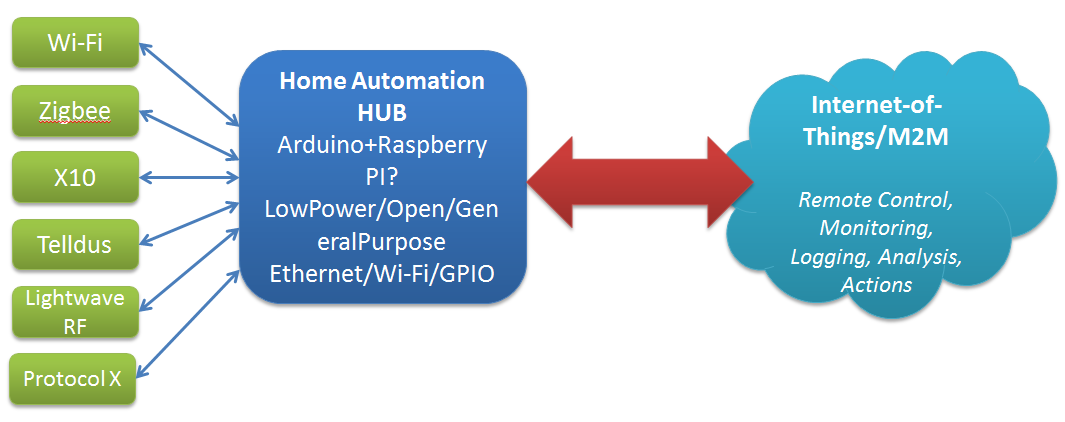
Think home sensors/lightbulbs/whatever – currently we have a plethora of specs to choose from for household comms and telemetry: X10, Zigbee, Z-Wave, Lightwave RF. Telldus, etc. Currently each manufacturer has their own choice of spec, controller software, etc.

Fortunately the Open Source/Open Hardware groups are are already experimenting with options to handle this – a good example is the Home Automation Hub (HAH) project which sets out to turn an Orange Livebox router into a home automation server, with an extra bit of hardware that – like the TellStick – allows it to control a range of gadgetry, and even keep an eye on energy consumption too. Likewise the dovado routers I’ve raved about before have the beginnings of some interesting Home Automation features with integration with Telldus sticks and the use of GPS to determine sunrise and sunset times for the location.

Open Source Open Hardware Hub

Home Hub - Internet of ThingsKey features as I see them are:

  • Compact
  • Reliable
  • Minimum Downtime
  • Low power
  • Open

Publish & Subscribe

So, assuming that we can get all these sensors talking to our hub, and that data recording (and potentially taking local actions based on that – heating, lighting, etc.) what do we do with it.

The hobbiest answer is to put it up on a website for your own entertainment. The more interesting options are open to the hub provider, and I see a few possible approaches here:

  1. Act as a relationship broker: making partnerships with different consumers of the telemetry e.g. allow the hub to submit information of the users choice to projects of their interest e.g. SmartCities, utility providers, etc.
  2. Act as a centralised clearing house: store all users data, sell it in bulk (users are the product) and plan to be bought at some point by Google/IBM/whoever
  3. Act as a centralised broker – grouping your users according to, for example, energy usage patterns and negotiating (optional) bulk deals from utility providers. For example, contacting the Power company and saying here is aggregate usage data for 30k ‘night owls’ – can we get a special deal, since they are offsetting the base load cost, but not adding to peak loads.


Providers/Website subscribing to the date